



Please Leave Us A Message
Privacy statement: Your privacy is very important to Us. Our company promises not to disclose your personal information to any external company with out your explicit permission.
 Guangzhou Huangzhipai Packaging Machinery Co., Ltd.
Why sterile powder filling deserves its own equipment class
Market demand explains the investment pressure. The aseptic fill-finish manufacturing market was valued at USD 6.48 billion in 2025, USD 7.06 billion in 2026, and is forecast to reach USD 15.10 billion by 2035, a CAGR of 8.83% ( Precedence Research, updated 27 Aug 2026). Vials remain the dominant packaging format — 36.4% of that market in 2024 — while Asia Pacific is the fastest-growing region.
The technical reason is different. In liquid filling, the dose is defined by volume, and volume is easy to control. In powder filling, the dose is defined by volume under vacuum, then discharged into a vial — and the mass that lands in the vial depends on the powder's bulk density, flowability and moisture. Two batches of the same API can behave differently on the same machine. That is why powder filling accuracy is always quoted with the phrase "depending on powder characteristics."
What is a sterile powder filling machine?
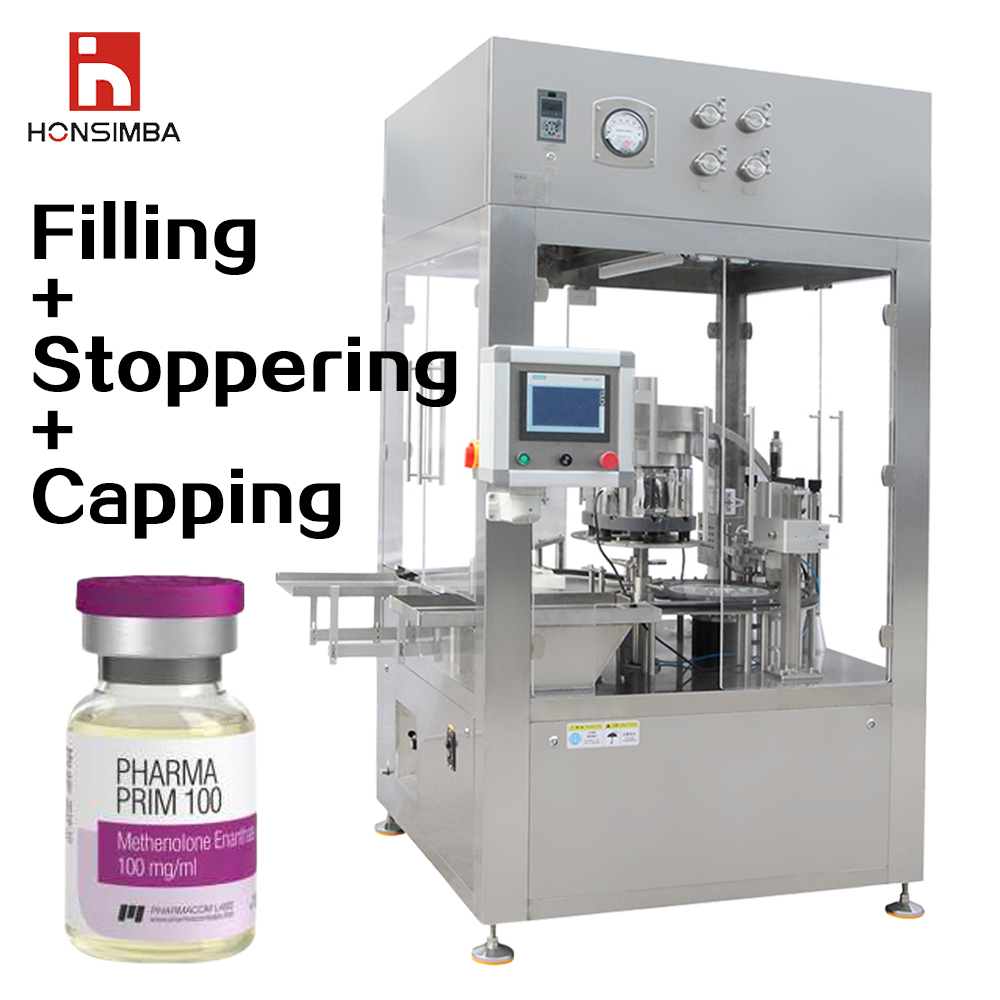
A sterile powder filling machine (also called a vial powder filler or injectable powder filling machine) is a machine that doses a precise quantity of sterile powder into washed and depyrogenated vials and closes them with sterile rubber stoppers. In most modern designs it is a monoblock: filling and stoppering happen on one platform, on one vial transport path, under one laminar flow or barrier enclosure, which removes a transfer step where contamination and powder spillage would otherwise occur.
Typical configurations:
--Single powder wheel — one dosing wheel, used for moderate output and small batch campaigns.
--Double powder wheel — two dosing stations for higher throughput, often used for antibiotic powder lines.
--Line-integrated version — the powder filler sits between a vial washer, a depyrogenation tunnel and a Capping machine to form a complete sterile powder filling line.
How a powder filling cycle actually works
The core dosing principle in most injectable powder fillers is vacuum dosing with pressure discharge. Here is the sequence, step by step:
1. Vial preparation. Vials are washed (often ultrasonic), sterilized and depyrogenated in a tunnel at high temperature, then transferred into the Grade A filling zone.
2. Powder agitation. Sterile powder in the hopper is agitated by mechanical agitators to keep bulk density uniform. Uniform density is the single biggest lever on fill-weight consistency.
3. Vacuum dosing into the powder wheel. A powder wheel with multiple ports rotates beneath the hopper. Each port contains a piston, and a vacuum plate sits behind the wheel. Vacuum draws powder into the port; the piston length determines the fill volume. Excess powder is scraped off by a doctor blade — on good machines, adjustable from outside without dismantling the hopper.
4. Discharge into the vial. When the port indexes above a vial, a short pulse of sterile compressed air or nitrogen flushes the powder plug into the vial. The plug stays in the port under vacuum until that moment, which is what prevents powder loss between filling positions.
5. Stoppering. Vials are separated on the conveyor and stoppered with sterilized, siliconized rubber stoppers fed from a vibratory bowl. Vials are held between timing belts, pick up the stopper, and pass through press rollers that seat it to the correct depth (partial insertion for lyophilization, full seating for non-lyophilized product).
6. Sealing and inspection. Vials move to a capping machine for aluminum cap sealing, then to checkweighing, visual inspection and, where required, container closure integrity testing.
Email to this supplier
Privacy statement: Your privacy is very important to Us. Our company promises not to disclose your personal information to any external company with out your explicit permission.
Fill in more information so that we can get in touch with you faster
Privacy statement: Your privacy is very important to Us. Our company promises not to disclose your personal information to any external company with out your explicit permission.